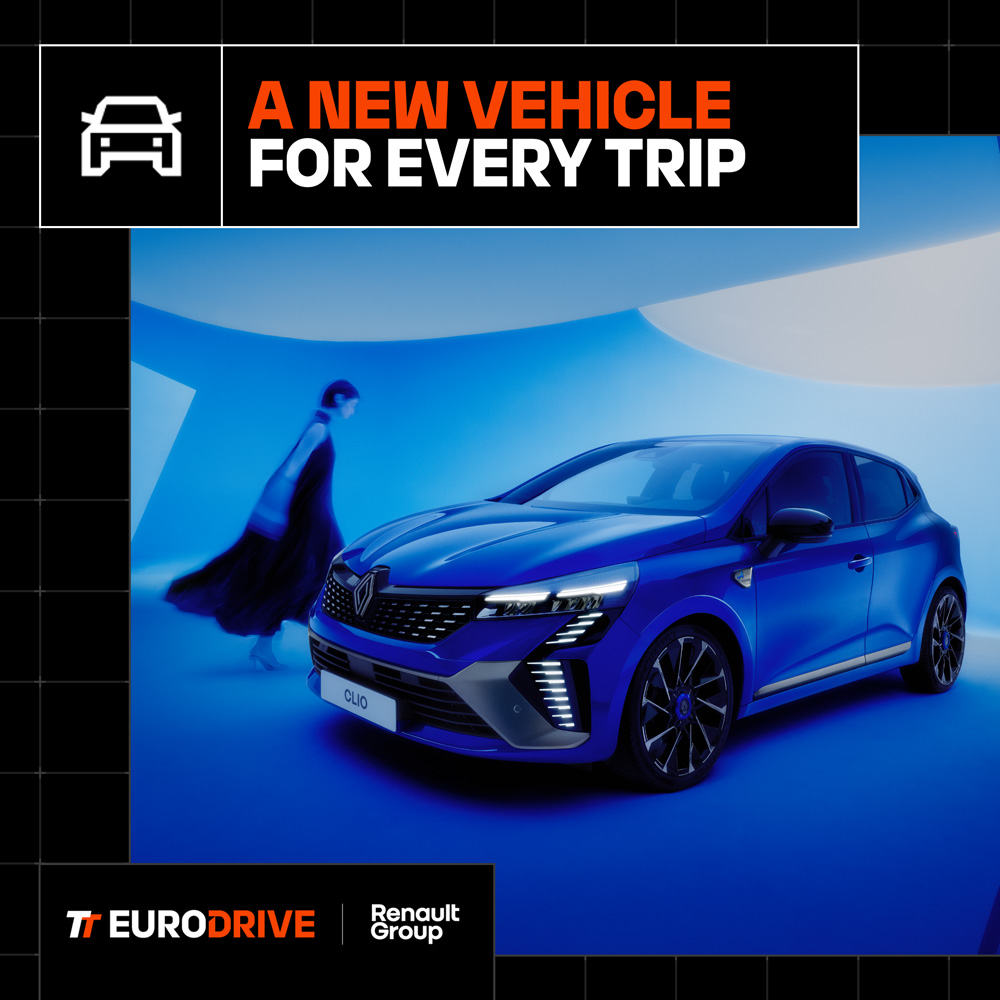
A short term car lease in Europe — known officially as Temporary Transit (in French, Transit Temporaire, or "TT") — lets travelers who pay their taxes outside the European Union drive a brand-new, tax-free Renault or Dacia for anywhere from a few days to 6 months (a minimum of 15 days is invoiced). You sign a purchase and a guaranteed buyback at the same moment: the car is registered and insured in your own name, exempt from VAT because it is formally destined for export, and taken back by Renault when you leave. That mechanism is why a temporary transit lease is also called a buyback lease, achat-rachat, or the Renault buyback program — and why zero-deductible all-risk insurance, 24/7 assistance, unlimited mileage and a free GPS come built into the price.
That is the definition; what follows is the practical guide. Travelers from the United States, Canada, Australia, New Zealand and Japan have been quietly using the program since 1954; here is everything they wish someone had written down for them.
The Program at a Glance
| Who qualifies | Tax residents outside the EU (USA, Australia…) and residents of the French overseas territories (DROM-COM) — where you pay your taxes counts, not nationality |
| Minimum driver age | 18, with a valid license recognized in the countries crossed |
| Duration | Up to 6 months, with no minimum trip length (a minimum of 15 days is invoiced); up to 355 days for students, interns, journalists, people on a mission |
| The vehicle | A brand-new Renault or Dacia in your name, wearing red Temporary Transit plates — you are its first driver |
| Tax | VAT-free by law under the French customs Temporary Transit regime, created in 1954 |
| Insurance | All-risk cover in your name, zero deductible on accident, theft, fire and glass (one legal exception: €380 on decreed natural disasters); 24/7 roadside assistance |
| Where you can drive | Nearly 40 European countries, islands included (Corsica, Sardinia, Madeira…) — the United Kingdom and Serbia are not covered |
| Additional drivers | Spouse, parents and children drive free — and anyone may take the wheel while you (or one of your drivers) are in the car |
| Included | Unlimited mileage; free GPS; 24-month manufacturer warranty; no full-tank requirement at return |
| Pickup and return | Centers across France, Spain, Italy, Portugal, Germany and Switzerland; one-way within France included |
| When to book | About five weeks ahead — documents due at least 35 days before delivery |
Is a Temporary Transit Lease Right for You? The Sixty-Second Check
The program is built for a specific traveler; if that traveler is you, almost nothing else competes. The lease is likely your tool if all of the following hold:
- You pay your taxes outside the European Union, or you live in a French overseas territory — whatever your passport says.
- Any trip length works — there is no minimum stay (a minimum of 15 days is invoiced), and the value builds the longer you keep the car.
- You will not take up paid work in the EU during your stay (a salary from a non-EU source is fine).
- Every driver is at least 18 — family drives free, and others may drive while you are aboard.
- Your route skips the United Kingdom and Serbia — the islands, from Corsica to Sardinia and Madeira, are all covered.
- You can plan about five weeks ahead — or use the fast track described below.
A classic rental remains the tool for EU residents, or when you need a car tomorrow morning. On price, though, the lease holds its own even on very short trips — with pickup and return outside France or Switzerland, it is usually cheaper than renting from the very first day.
How Temporary Transit Works — and Why It Is Tax-Free
Temporary Transit is neither a rental nor a conventional lease: it is a short-term purchase with a guaranteed repurchase, signed together. Under a customs framework France created in 1954, a visitor who lives outside the EU takes delivery of a factory-new vehicle free of VAT, because the car is formally destined for export. Renault commits, in writing and in advance, to buy it back at the end of your stay; what you pay is, in effect, the difference between the two prices, with insurance, assistance and mileage already inside.
Seven decades on, the framework endures — and so does its signature: the bright red license plates of a vehicle in Temporary Transit, fully legal across Europe, telling customs and police at a glance that the car is tax-exempt and registered to a visiting owner. Renault is not alone in this market — Peugeot, Citroën and DS offer Temporary Transit vehicles under the same customs law — but this program is Renault's, operated by Renault Eurodrive, a brand of the ATI group, Renault's historic partner for the scheme.
Who Is Eligible for a Short Term Car Lease in Europe?
Eligibility is defined by where you pay your taxes, not by the passport you carry, and the conditions are cumulative: tax residence outside the EU customs territory (or in a French overseas territory such as La Réunion, Guadeloupe, Martinique or French Polynesia), a temporary stay in the EU, and no paid activity during that stay — unless your salary comes from a non-EU source. The rules come straight from French customs law (official source: douane.gouv.fr). Travelers from the United States, Canada, Australia, New Zealand, Japan, Singapore, Brazil, Mexico and beyond qualify — and so do French and EU citizens living outside the EU, because tax residence, not nationality, is what counts.
The minimum driver age is 18, with a valid license recognized in the countries you cross — a notably lower bar than car rental, where drivers under 25 often face higher minimum ages and young-driver fees. If you live inside the EU the standard scheme is not open to you, with two narrow exemptions: people reassigned outside the EU within six months of returning to Europe, and EU residents about to move to a third country (three months, with proof of the move). Full conditions are on our learn more page.
Students, Interns and Journalists: Up to 355 Days
The six-month ceiling has a generous exception. Students, interns training in professional, artistic or cultural fields, journalists, and people on a mission for an establishment based outside the EU can benefit from the regime for up to 355 days — and for them, the no-paid-activity condition is lifted. A study-abroad year in Lyon fits comfortably inside the formula.
Who Can Drive the Car?
The registration certificate carries one name — yours — but the wheel was made to be shared. Your spouse, your parents and your children drive at no extra cost, provided each meets the same conditions (non-EU tax residence, valid passport, valid license). And the rule is more generous than most travelers expect: anyone may take the wheel as long as you — or one of your authorized drivers — are in the car. The friend who joins you for a week can share the mountain passes; just stay aboard while they drive.
Lease vs. Rental: The Honest Cost Comparison
Leasing usually wins, and the longer the trip, the more clearly — while with pickup and return outside France or Switzerland it is usually cheaper from the very first day. The reason is structural: everything a rental counter sells as an extra is in the lease from the first quote, and the price cannot vary after booking. Most people arrive here after pricing a long term car rental in Europe; here is the honest side-by-side.
| Criteria | Renault Eurodrive Temporary Transit | Traditional car rental |
|---|
| Cost on long trips | No minimum trip length (15 days minimum invoiced), up to 6 months; the daily cost falls the longer you drive | Daily rates stack up; long-stay discounts are limited |
| Vehicle | Brand-new — you are the first driver, in the exact model, engine and transmission you chose | Fleet car with previous renters' wear, assigned as "or similar" |
| Minimum driver age | 18, with a valid license recognized in the countries crossed | Often 21 or higher, plus young-driver fees |
| Insurance | All-risk cover included, in your name | Basic cover; full protection sold as an extra |
| Deductible (excess) | None on accident, theft, fire, glass — even misfuelling (every car runs on gasoline, hybrids included); only loss of the registration document is not covered | Often substantial unless you buy a costly waiver |
| Mileage | Unlimited | Unlimited on some contracts, capped on others |
| Additional drivers | Spouse, parents and children free; anyone may drive with you aboard | Typically charged per driver, per day |
| Fuel at return | No full-tank requirement | Full-to-full policies, refueling penalties |
| GPS | Included free | Usually a paid daily extra |
| One-way trips | Included within France | One-way fees common |
| Registration | In your own name, with red Temporary Transit plates — so border crossings are easy | In the rental company's name |
| Early return | Unused days refunded | Refunds are rare |
Price out a 60-day trip for two drivers: with a rental, the second driver, the zero-excess protection and the GPS are line items that quietly inflate the bill; here they are in the deal from the start. And the arithmetic is not reserved for long stays: outside France and Switzerland, the lease usually beats a rental even for a single day. Seasonal offers run all year, so check the current discounts before comparing quotes.
Planning Your Lease: From Booking to Delivery Day
Your car does not come off a lot — it is registered in your name, plated and insured before your flight lands — so the timeline runs backwards from your pickup date:
- Five weeks out (or earlier): reserve — vehicle numbers are limited. Confirmation arrives within 24 hours; payment can be made in one or two installments.
- At least 35 days before delivery: upload or e-mail your documents. The car is then registered in your name between 21 and 5 days before pickup — once registered, changes are refused (earlier ones are possible, subject to the manufacturer's approval).
- Deliveries abroad can need more lead time — up to 42 days in some cases.
Running late? An order can be accepted up to 10 days before delivery on one condition: the vehicle must already be at your chosen delivery center, and your complete file must arrive within 24 hours.
The Documents You Will Need
For every traveler, three items: a copy of your valid passport (or national ID card for overseas-territory residents), a copy of your valid driving license, and the order form — generated and pre-filled at the end of your reservation. EU nationals living outside the EU add one proof of residence: a consular card, visa or resident card; two utility bills (one older than six months, plus the latest); a tax notice; or a residence certificate. EU nationals in the overseas territories add two utility bills — plus a CPS card copy in French Polynesia.
Accessories: Decide at Booking, Not at the Counter
Because each vehicle is prepared specifically for you, accessories follow the same rhythm as the car: a child seat, winter tires or any other extra must be requested with your reservation and paid with the order — there is no shelf of last-minute extras at the delivery center. And because this is a purchase, accessories are bought, not borrowed: that child seat is yours outright — take it home at the end of the trip, or simply leave it in the car.
You choose the model, engine, transmission, equipment and accessories — everything except the color, which the manufacturer picks in sober, sellable shades for resale.
If Your Plans Change: Cancellation, in Plain Numbers
Cancellation is free up to 31 days before the delivery date. At 30 days or less, a €300 fee applies — €1,000 if the vehicle is already registered in your name. Worth knowing: banks prohibit refunds to a credit card when the payment is 30 or more days old, so in that case the refund arrives by bank transfer. One honest note for US customers: American cooling-off laws generally do not apply to remote vehicle contracts with European suppliers — this policy is offered voluntarily and published in the terms and conditions.
Delivery Day: The Handover
You arrive at one of more than twenty centers in six countries — including several at major airports; find yours on the delivery centers page — and your car is waiting: factory-new, red plates fitted, insurance certificate in your name, accessories installed or in the trunk. An agent walks you through the major equipment before you drive off.
One habit to adopt in the first five minutes: never drive with the original registration document — keep a copy in the glovebox and the original somewhere safe; a lost, stolen or unreturned original costs from €500 up.
Where Can You Drive? Nearly 40 Countries — and a Few Exceptions
Insurance and 24/7 assistance are valid across nearly 40 European countries: Andorra, Austria, Belgium, Bosnia and Herzegovina, Bulgaria, Croatia, the Czech Republic, Denmark, Estonia, Finland, France, Germany, Gibraltar, Greece, Hungary, Iceland, Ireland, Italy, Latvia, Liechtenstein, Lithuania, Luxembourg, North Macedonia, Malta, Monaco, Montenegro, the Netherlands, Norway, Poland, Portugal, Romania, San Marino, Slovakia, Slovenia, Spain, Sweden, Switzerland and the Vatican.
Anything not on that list is off-limits — the notable absentees being the United Kingdom and Serbia, along with Albania, Kosovo, Turkey and Ukraine. The United Kingdom is the costly one: take the vehicle to England and you owe VAT on the brand-new price of the car — extra equipment included — plus customs duties. Nor can you engineer around the map: buying separate insurance to visit a country outside the list is contractually prohibited, assistance cannot intervene there, and the documented risk is a car blocked by customs at the EU border, with VAT demanded on the new-vehicle price. Plan inside the map; it is enormous — islands included, from Corsica and Sardinia to the Balearics and Madeira.
Tolls, Vignettes and City Rules
Road rules change at every border, and checking each country's legislation — traffic rules, tolls, motorway vignettes, urban traffic schemes — is the driver's responsibility under the contract; a few minutes on each country's official sites is the cheapest insurance there is. One welcome simplification: in France, the CRIT'AIR sticker is no longer required for new vehicles under the Temporary Transit regime.
Winter Driving and Mountain Roads
Vehicles come with all-season/summer tires, at their best above 7°C; some carry Mud & Snow tires — but where winter tires are legally required, those are not approved winter equipment. Heading to the mountains in winter? Order winter tires as a paid option when you book — a decision for reservation day, not the first snowflake.
Ferries and Islands
The covered territory includes islands large and small — Corsica, Sardinia, Sicily, the Balearics, Madeira, Malta, Iceland, Ireland, the Greek islands — so ferries figure in many itineraries, and taking one is perfectly fine. During the crossing the vehicle travels under the ferry operator's responsibility; note only that the TT insurance itself excludes partial damage during sea transport — and that no ferry makes the United Kingdom covered.
What the Insurance Covers — and What It Does Not
Every vehicle comes with full-coverage, all-risk insurance in your own name, with no excess on the claims that keep travelers up at night — a scraped bumper in a tight Barcelona garage does not become a vacation-souring negotiation.
Covered, with zero deductible:
- Accidental damage and vandalism
- Fire, explosions, terrorist attacks, lightning and storms
- Theft and attempted theft
- Glass — windscreens, windows, lights, sunroofs
- Punctured tires — and even misfuelling (easy to avoid anyway: every car in the range runs on gasoline, hybrids included)
Also included: civil liability per the French Insurance Code, with unlimited cover for bodily harm and material damage covered up to €100,000,000; passenger cover for everyone carried, over-70s included — medical costs up to €5,000 per injured person, €38,000 for total permanent disability, €16,000 in the event of death; and 24/7 roadside assistance.
Not covered — know before you go:
- Stolen personal effects, objects and accessories — travel-insurance territory, not car insurance
- Loss of the registration document (lost keys are handled by the Assistance, provided you call them first to open a file)
- Damage from poor maintenance or wear, or anything covered by the manufacturer's warranty
- Partial damage during transportation by sea or air
- Natural disasters carry the one legal exception to "no excess": a €380 deductible, in mainland France and Corsica, when an official state of natural disaster is decreed
The paperwork is relaxed, too: hand in the accident report at your convenience — at the latest when you return the car.
What Happens If the Car Breaks Down or Has an Accident?
If a red or orange warning light appears, stop and call Assistance — +33 1 84 95 96 97 (01 84 95 96 97 within France) or das@ima.eu, staffed 24/7 — and follow their procedure. Pressing on counts as misuse, and repairs the warranty would have covered get charged back.
If the vehicle is immobilized after an accident, Renault Eurodrive provides a replacement rental car of maximum equivalent category, subject to availability, so the journey continues. The replacement comes through a traditional rental company — expect a credit-card imprint — but your original TT insurance applies to it, full comprehensive with no excess. Decline the rental desk's extra options: they will not be reimbursed. Also: collect your repaired car within 24 hours, and no compensatory travel allowance is granted after a claim.
Staying Longer: Extending Your Contract Mid-Trip
Europe rearranges plans. Extend your contract during your stay with a phone call to the extensions service — +33 1 76 84 99 00 from abroad, 01 76 84 99 00 within France — armed with a credit card and your car registration. The rate is €40 per day, all models, and a new insurance certificate arrives by e-mail. Do not simply keep the car past its return date: an overrun without prior extension incurs per-day charges that make the €40 rate look friendly.
Return Day: How to Hand the Car Back
The return is where the buyback lease pays off. Arrange your drop-off 5 working days before the due date by e-mail (for Lisbon call +351 21 846 27 97, for Porto +351 22 996 64 27 directly), stay reachable for the confirmation, and hand the car to any approved center. One-way within France is included — pick up in Paris, drop in Nice, no fee — and you can change your return center until 5 working days before drop-off (one caution: if your contract plans a return in France and you drop the car outside France or Geneva instead, drop-off fees are charged). There is no full-tank requirement, and a nearly empty tank, scratches — even significant damage — cost nothing extra, because the all-risk insurance absorbs them: the price agreed at booking is the price. Return early and unused days are refunded.
Two numbers to keep in mind. Delivery or return at a center outside France or Geneva: €200 per operation, whether planned from the start or not. Abandoning the vehicle anywhere other than an approved center: a penalty of €500 in France or €1,500 abroad, plus every associated cost (transport, storage…). With centers in six countries there is nearly always a better option — see the network map.
Keeping the Car: The Definitive Purchase Option
Some travelers arrive at the return center planning a goodbye and instead ask how to make it permanent. It is possible, with conditions: the definitive purchase is available in mainland France only, for clients with a current contract, with a mainland-France address (yours, or family's or friends') for the registration document. The price applies a depreciation of 10% to 25% to the total price of the vehicle with options, all taxes included: contact the customer managers no later than 15 days before your return date (+33 1 76 84 99 00, or adv1.eurodrive@renault.com) with your contract number, and the exact figure comes back within 48 hours. The transaction is handled by a used-vehicle representative at the Renault Boulogne-Billancourt branch, which manages the new registration and can offer financing; the registration certificate costs extra, and you arrange your own insurance from the day the TT contract expires. Requests made after the return cannot be considered, so call before the last drive.
Frequently Asked Questions
Is it cheaper to lease or rent a car in Europe?
A Temporary Transit lease usually compares very favorably: everything rental companies sell as extras — zero-deductible insurance, additional drivers, unlimited mileage, GPS — is included from the first quote, and the daily cost falls the longer you drive. With pickup and return outside France or Switzerland, the lease is usually cheaper than a rental even for a very short trip.
How far in advance should I book a short term car lease in Europe?
As early as possible — vehicle numbers are limited. Documents are due at least 35 days before delivery, and the car is registered in your name between 21 and 5 days before pickup, so five weeks is the comfortable planning window. Late orders are possible up to 10 days out only if the vehicle is already at your chosen delivery center and your complete file arrives within 24 hours.
What is the minimum age to lease a car in Europe?
18 years old, with a valid driver's license recognized in the countries you cross — a sharp contrast with car rental, where under-25 drivers typically face higher minimum ages and daily fees on top of the rate.
Can I pick up the car in one city and return it in another?
Yes. One-way within France is included at no charge, and you can change your return center until 5 working days before drop-off — drop-off fees apply if a return planned in France happens outside France or Geneva. Pickup and return centers operate across France, Spain, Italy, Portugal, Germany and Switzerland; returns are arranged by e-mail 5 working days before your due date.
Can I take the car to the United Kingdom?
No. The United Kingdom is not covered by the contract (nor are Serbia, Albania and Kosovo), and taking the vehicle to England exposes you to VAT calculated on the brand-new price of the car, extra equipment included, plus customs duties. Buying separate insurance to visit any non-covered country is also contractually prohibited.
Do I have to return the car with a full tank?
No. The price cannot vary after booking: returning the car with a nearly empty tank — or with scratches, even significant damage — triggers no additional charge, because the all-risk insurance absorbs it. You hand the vehicle back at an approved center and the pre-agreed buyback simply takes effect.
Can I buy the car at the end of the lease?
Yes, if you are keeping it in mainland France and can provide a French address for registration. A depreciation of 10% to 25% is applied to the price of the vehicle with options; request your exact quote no later than 15 days before the return date and it arrives within 48 hours.
Ready for the Open Road?
Some trips deserve better than a rental counter. For more than seventy years, Temporary Transit has offered travelers from outside the EU something rare: a brand-new car of their own, tax-free, insured in their name, valid across nearly 40 countries — and never a glance at the odometer. The program is run by Renault Eurodrive, a brand of the ATI group, in the tax-free lease market for more than 40 years; read who we are before entrusting a season of your life to us.
Browse the range of Renault and Dacia models on the vehicles page, gather route ideas on the travel blog, and if you are wondering whether a 40-day loop through France, Spain and Italy fits the formula — it does, beautifully — contact us (toll-free from the US: 800-294-5905) and we will help you plan it. Confirmation arrives within 24 hours; the red plates and the open road follow.


 EURODRIVE